
Real project
Industrial automation 01 / 2026
RV-510Six-track perforation inspection
In-line quality control installed on a six-unit OMET printing press, after the rotary die cutter. Its standalone architecture allows adaptation to other equivalent printing lines.
Explore the case study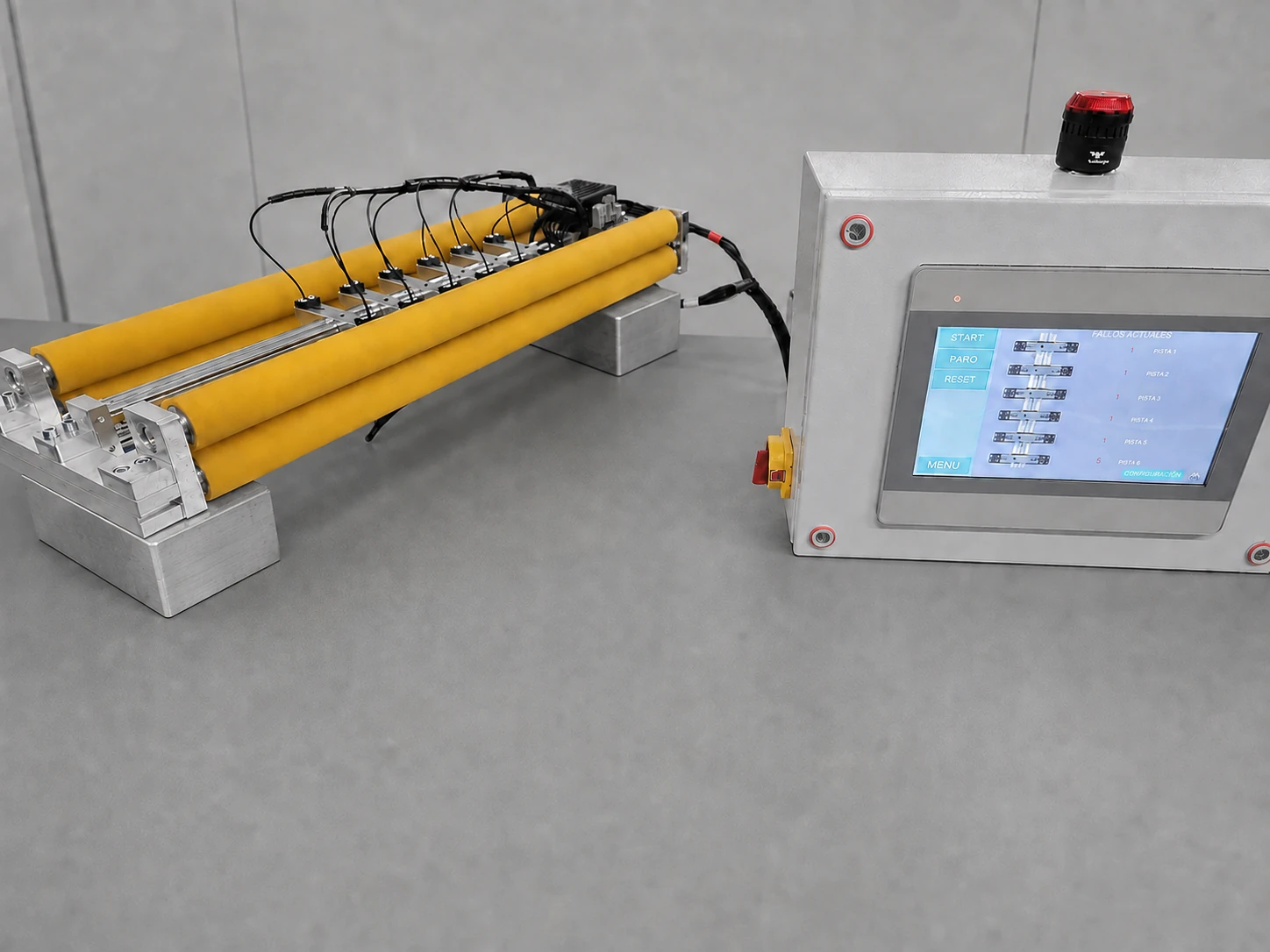
The project at a glance.
- The problem
- Defective perforations were detected too late. The line needed to locate the incident before slitting the roll.
- The intervention
- Mechanical and electrical design, PLC/HMI controls, assembly and integration of six inspection tracks. Machining was outsourced.
- The observed result
- Detection of the defects deliberately introduced during testing, with alerts and logs by roll and track, without stopping the line. This is not a statistical detection guarantee.
The problem
A millimetre-scale defect with downstream consequences.
A rotary die cutter creates small circular perforations that later serve as references in automatic dispensing or verification equipment. If a cut is incomplete or the cut-out does not detach, the reference is lost and the downstream equipment may jam.
The line speed made reliable visual inspection impractical. Inspecting every roll afterwards allowed material to be recovered, but was not scalable: the defect had to be detected at source without interfering with the main machine.
Development


From the need to the equipment
Complete development, starting with functional definition.
The detection principle had previously been validated on a rewinder to inspect individual units. RV-510 brought that knowledge to the die-cutter output and expanded it to six simultaneous tracks.
The scope included mechanical and electrical design, component selection, PLC and HMI programming, coordination of outsourced machining, assembly, integration and on-machine testing.
The documented unit was configured for two compatible OMET lines. The same architecture can be adapted to other presses with rotary die cutters through the appropriate integration modifications.
The comparison follows the progression from the mechanical model to aluminium parts and the completed adjustable assembly. The cover shown in the CAD model is not presented as a manufactured component.
- Control integration
- Standalone operation
- Installation
- 4 bolts + power supply
- Adaptability
- Lines with rotary die cutters
Architecture
One adjustable head. Six independent channels.
Four passive rollers guide the web. Six adjustable brackets are distributed across four bars, aligning the fibre-optic sensors with the path of each perforation.


The controls use a Siemens S7-1214C, an HMI and an audible and visual beacon. The cabinet houses the fibre amplifiers and control components. Operation does not depend on signals from the press's original controls.
Control logic
Adaptive time-based detection
The distance is constant. The time is not.
During start-up and stopping, the interval between perforations changes. The control updates its reference with each valid reading to follow those speed ramps without mistaking them for a defect.
- 01
Detect
Each sensor records the passing perforations on its track.
- 02
Measure
The PLC calculates the interval between consecutive detections.
- 03
Adapt
The timing reference follows the speed ramps.
- 04
Record
A missing perforation generates an event linked to the roll and track.
Operating principle shown. Parameters, tolerances and detailed logic remain confidential.
On-machine testing
Deliberate defect. Real response.
The video shows the web in production, a deliberately obscured perforation and the system's response through the beacon, HMI and log.
Tests covered all six tracks, simultaneous faults, several consecutive missing perforations, and acceleration and deceleration ramps. The introduced defects were detected and the beacon, display and log responses were checked. This evidence describes the tests performed; it does not constitute a statistical detection guarantee.
Interface and data
From immediate alerts to traceability.
When an incident occurs, RV-510 identifies the track, increments the counter and retains the event with the roll identifier, date and time. The quality team can export the history as CSV via USB.


RV-510 inspects and records but does not stop the OMET. A direct stop could affect the process. An incident temporarily activates the beacon, identifies the track on the HMI and saves the event with the roll, date and time. After slitting, the quality team can locate the individual rolls corresponding to the flagged tracks.
The interface and data entry were adjusted to simplify use during roll changes.
Result
Control at source
Inspect what is flagged, not all production.
RV-510 moved inspection from a later check of individual rolls into the production process itself. This made it possible to identify the defect by roll and track and focus inspection only on the flagged material.
After validation, the equipment became part of the regular workflow for jobs requiring this control.
- 01Machine design
- 02Integration and retrofit
- 03Fibre-optic sensing
- 04PLC programming
- 05HMI design
- 06Quality traceability
Articles
Related articles
A closer look at the decisions behind this solution.
Before designing, I look at what I have to hand
How I approach an industrial problem when the same person analyses it, designs it, makes it, wires it and gets it working. And why the best solution is often not the most spectacular one.
Read the articleHow to design a control that does not let the defect through
Detecting the fault is the easy part. The difficult part is deciding what the system does when it finds one, and getting that right.
Read the articleYour next step
Do you have a similar problem?
We can assess a solution tailored to your machine or process.