
The starting material

The batch starts with bronze stock from which the new backing pads are machined.
Parts, spares and short production runs
A short production run of sacrificial backing pads for a card chip insertion machine. A design change to make use of both faces of each replacement part.
Explore the improvement
During milling of the chip cavity, the plastic card rests on a bronze backing pad. If the operator programs an excessive milling depth, the cutter damages this sacrificial part instead of the machine.
The brief was to manufacture a short production run of replacement parts. Previously, when the usable face of a backing pad was damaged, the whole part was discarded. At 7Axis, we proposed improving the design to give it a second use.
At 7Axis, we redesigned the geometry so both faces could be used. This was our own proposal: when one face is damaged, the backing pad can be turned over and the other face used, without manufacturing another replacement.
The first face supports the card and acts as a sacrificial surface.
If the first face is damaged, the part is turned over and the second face is used.
We machined a short production run from CuSn7Zn4Pb7-C bronze using the new reversible design.
The batch starts with bronze stock from which the new backing pads are machined.

The ten parts are arranged in two rows on a shared fixture. CAM preparation defines the toolpaths around their contours to machine the batch.
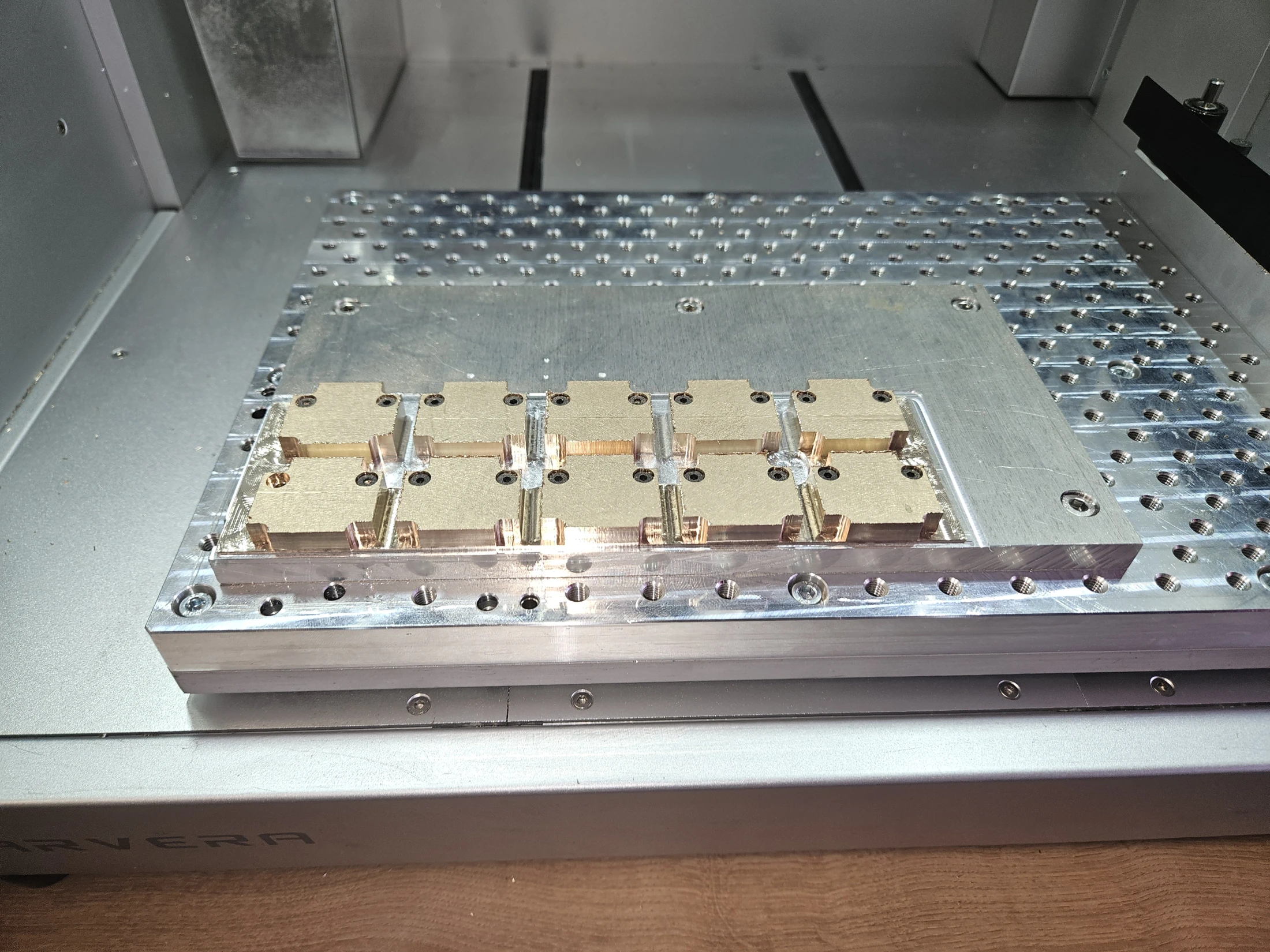
The video shows the batch being machined. The geometry of the backing pads takes shape in the starting material.
Parts in service
The new backing pads were installed in the card chip insertion machine and are working correctly in production.
Previously, the part was discarded after one face was damaged; now a second face remains available. The same replacement part can therefore be used twice before being replaced.
On another machine with automatic height adjustment, we tested technical resin backing pads to replace the original bronze parts. Their performance in service allowed us to retain this alternative and manufacture batches at a lower cost.
We also tested resin on the manually adjusted machine in the main case study, but breakages during adjustment led us to choose bronze and develop the reversible design. The parts have different geometries: we select the material according to each machine's actual operating conditions.


Articles
A closer look at the decisions behind this solution.
A discontinued spare, with no drawing or data sheet. Before machining anything, one question needs answering: what is this made of?
Read the articleYour next step
We can assess a solution tailored to your machine or process.